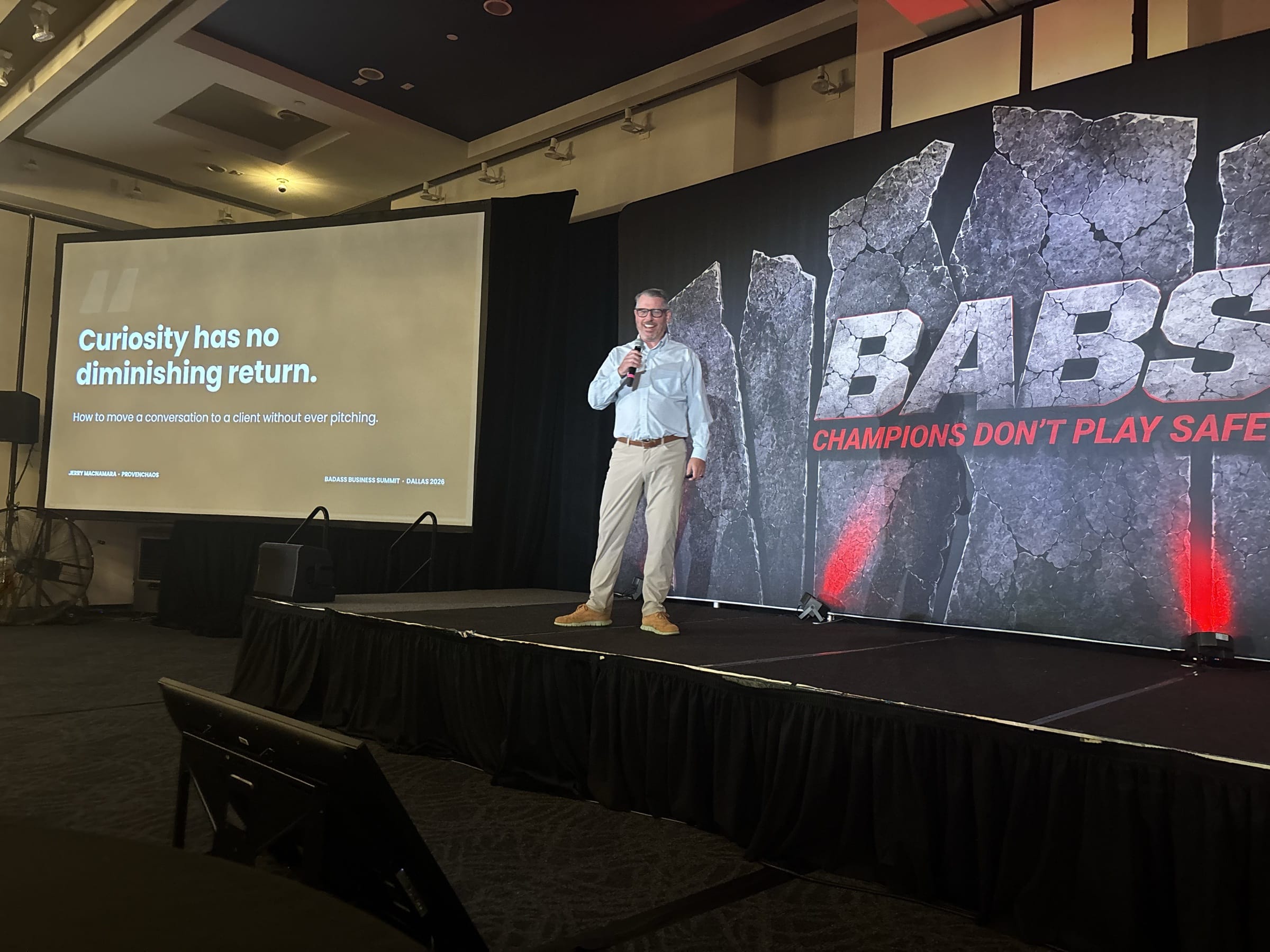
Keynote and workshop
How to Move a Conversation to a Client Without Ever Pitching
You know the moment. Someone at an event describes the exact problem you solve, and you either freeze and ask about the kids, or you pounce with “We do that!” and watch them take half a step back. Same fear under both: I don’t want to be that guy. This talk, delivered from the main stage at the Badass Business Summit 2026 in Dallas, shows your room the third option. It is questions the whole way. The only thing that changes is what the next question asks for.
What the room walks out with
Curiosity has no diminishing return. The tenth good question builds more trust than the first. A pitch loses it by the second sentence. Most people in your room already own the only skill this requires: they can listen, and they do not need to talk. They are not missing courage. They are missing the next question. This talk gives them three of them, and one rule that keeps them from ever being pushy again.
- The Curiosity question. Aimed at the problem you solve, and it never mentions what you do. “What is the part of the business you wish ran without you?” Then the follow-up to every answer: “Tell me more about that.” Five of these find the problem before anyone has said a word about a service.
- The Permission question. The whole move, in one sentence. “Can I ask you a couple more questions about that? It is the thing I spend most of my time on.” One clause of honest relevance, and it is still a question. Then hand them the door: is this something you are actively trying to fix, or more of a live-with-it right now? A “live with it” is not a no. It is a follow-up date.
- The Next Step question. Books the meeting, never the sale. “Is it worth thirty minutes next week to go through it properly? I do not know yet if I am the right person for this. That is what the thirty minutes is for.” It is true, and true is the thing an introvert can say without flinching. Calendar out, on the spot. If it is not booked, it does not exist.
The framework it teaches
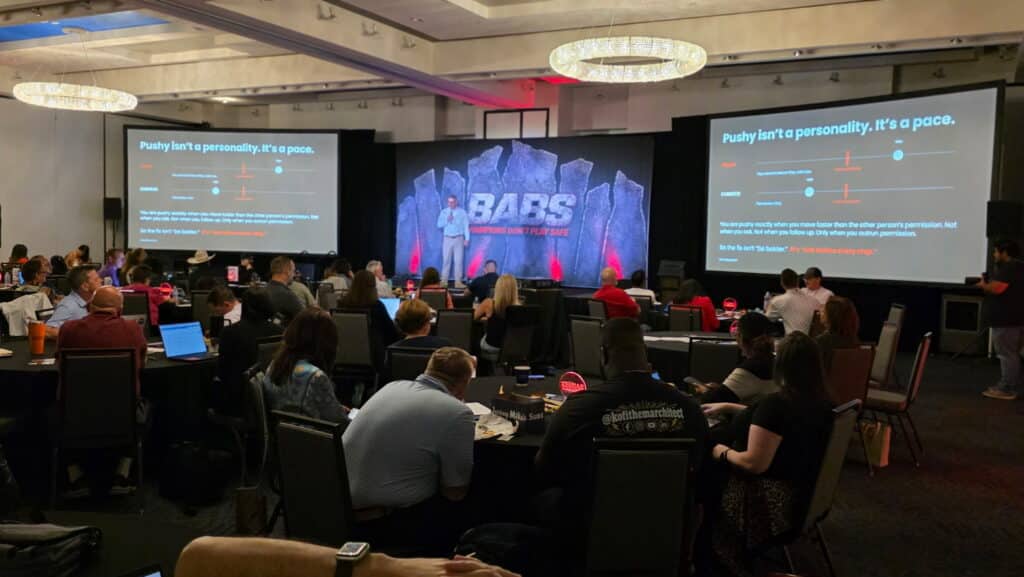
Three stages, two gates, three questions. A conversation becomes an opportunity when you have earned the right to go deeper, and an opportunity becomes a conversion when the next meeting is on the calendar. Each gate is a question, never a statement. The one rule that holds it together: never take a step you did not ask for. Pushy is not a personality. It is a pace. You are pushy exactly when you move faster than the other person’s permission, so the fix is not “be bolder.” It is “ask before every step.” The talk also gives the room three exits that are all questions, so a no becomes a date, an intro, or a referral instead of a dead end. The posture underneath it is Curiosity over Conviction, written up on ProvenChaos so your people can go back to it after the room empties.
Formats
Keynote. The version Dallas saw: a main-stage talk that ends with every person in the room writing their own three questions and saying them out loud to a neighbor. Nobody leaves with notes. They leave with words they have already said once.
Sales kickoff session. Built for a team that sells the same thing to the same kind of buyer. We write the three questions for your offer, in your buyers’ language, and rehearse the exits until “just send me some information” stops ending conversations.
Half-day workshop. For founders, partners, and anyone who hates selling but has to. Longer on practice, with the pocket card in hand and real prospects on the whiteboard. Every version is calibrated to your room: tell me who is in the seats and who they need to have conversations with, and I will build it around those.
Who books this talk
- Networking organizations and business summits. Rooms full of owners who meet a hundred people a year and convert almost none of them. The Badass Business Summit put this on its main stage for about 200 people in 2026.
- Sales kickoffs. Teams that pitch too early because nobody ever taught them what to ask instead. See sales kickoffs.
- Founder and professional-service firms. Consultants, agencies, advisors, and anyone whose best work walks in through a conversation and whose worst instinct is to describe their service the moment they hear a problem.
Questions planners ask
Is this a sales talk?
It is a conversation talk that happens to produce clients. Nobody in the room learns a pitch, a script, or a close. They learn three questions and one rule, and the only thing they ever ask for is the next step. It works for people who would never call themselves salespeople, which is most founders. See everything I speak on.
Does it work for introverts?
It was built for them. Every line in the method is true, and true is the thing an introvert can say without flinching. The person who listens well and hates talking about themselves already has the only skill this requires. The talk just hands them the next question.
Is there an exercise?
Yes, and it is the point of the talk. Near the end, everyone writes their own three questions, then says all three to a neighbor out loud. Two minutes to write, one minute to pair. People leave having said the words once, which is the difference between a good idea and a habit. A pocket card goes home with them.
How is it different from the Influence keynote?
Influence: The Intersection of Authenticity, Intention, and Trust is about getting things done with people you do not control, inside and around your company. This talk is narrower and more practical: one kind of conversation, with a stranger who might become a client, taken from hello to a booked meeting. Many rooms book Influence for leaders and this one for everyone who sells.
Check availability
Send the date, the room, and what you need the audience to walk out with. I answer every inquiry myself.