Your business is killing you, and you’re calling it ambition.
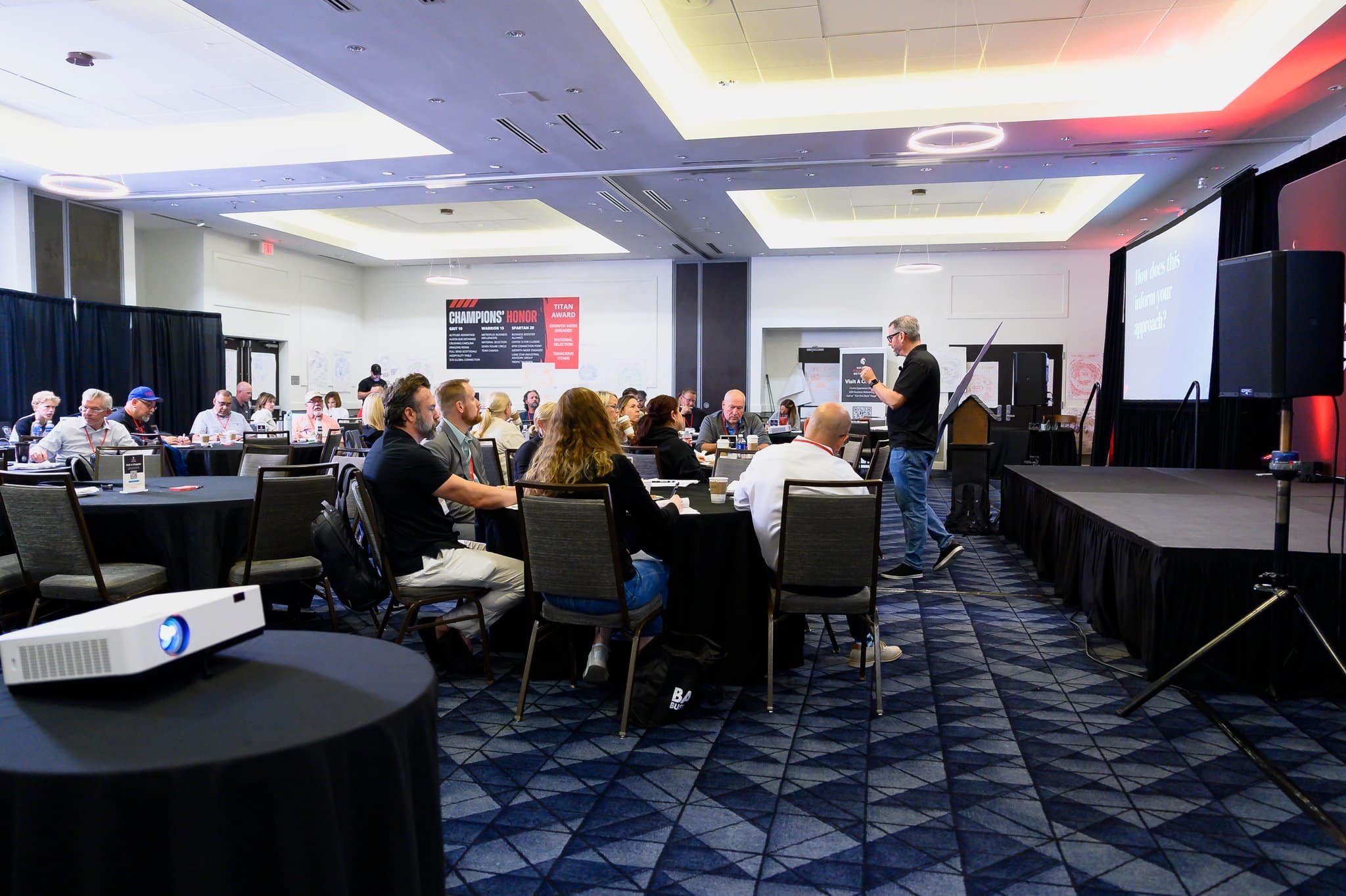
I gave this talk at the Badass Business Summit and opened with seventeen slides of numbers on what running a company does to the person running it. Burnout, blood pressure, sleep, marriages, the whole list. The next slide says what everyone in the room is thinking: Jerry, you’re scaring the shit out of us. Why? Fair question. Because awareness precedes action, and most owners have never looked at the bill.
I know the bill because I paid it early, and I’ve written about that elsewhere. What it taught me is that you can’t outwork scale, and a business that needs you broken to grow isn’t a business. It’s a hostage situation you’re running.
So before we talk about offers, cash flow, or margins, we have to talk about why you’re doing any of this. That’s the equation.
The Entrepreneur’s Equation
The Entrepreneur’s Equation is Intention + Execution = Fulfillment. You decide what the business is for, you build it to deliver that, and the payoff is a life you actually wanted instead of a bigger version of the one that’s grinding you down.
Most owners only ever work the second term. They execute. They’re very good at it. Execution without intention is blowing like a leaf in the wind: a lot of motion, no say in where you land. That’s how you end up financially wealthy and emotionally bankrupt, which is the one outcome I tell every room is a loss. You got the money and lost the game.
Intention starts uncomfortably far upstream. I ask two questions and give people two minutes each.
First: what is the purpose of your life? Not the mission statement. Yours. Mine is to have an insane amount of fun by loving, inspiring and supporting people to lead a fulfilled life while leaving the world a happier, better place. Say yours out loud and notice how little of your calendar points at it.
Second: what do you want the business to do for you? Finances, significance, security, travel, retirement. Be specific. A company is a tool. It has no purpose of its own, and if you don’t give it one it will happily consume you as its purpose instead.
Once you’ve answered those, two things follow. You know what you’re building, so you stop just doing shit. And you know whether your why is bigger than your excuses, because now you can check.
Execution, in order
Here’s the execution half, and the order matters more than the effort.
Stage one is sales and marketing. The warnings at this stage are cash flow and the offer. Stage two is systems and processes, where the warnings are not documenting, and automating too early. Stage three is a leadership team and technology, and the warning there is that you can’t overinvest your way out of the first two. Owners skip stages constantly. They buy software before they have a sale worth repeating. They hire a leadership team to run a process that was never written down.
Stage one lives or dies on the offer, and the offer lives or dies on the problem. A client of mine, Greg Rosner, has a line I steal on stage: don’t offer haircuts to bald men. Solve an important, painful problem. Better: solve a Monday morning problem, the one your customer wakes up dreading. Know exactly who has it and where they hang out. Then make the offer so lopsided in their favor that saying no feels dumb: a ninety-day return, a payment plan, something free thrown in, and proof that it performs. That’s a Mafia Offer. A Mafia Offer doubles the goodness the customer receives at half the price. It blows clients away, and that’s what makes it one they can’t refuse.
If you’re thinking “I’m not good at selling,” I’d push back on the premise. If you solve a real problem for real people, you have a responsibility to serve them. Not selling is a failure to serve.
Where the equation breaks
Execution has traps, and I’ve watched good owners fall into every one of them.
You don’t value your time, and you don’t pay yourself for your work. If the owner is the cheapest labor in the building, the model is lying to you.
One customer is more than ten percent of revenue. That’s not a customer. That’s a boss who can fire you.
Playing at business instead of doing business. Half of an owner’s week goes to things that don’t reasonably drive revenue. Before you say yes to anything, ask: will this reasonably drive revenue? If the honest answer is no, it’s a hobby with a logo.
Trying every marketing method. You need one or two channels to get to a million dollars. Not nine.
And the model itself. Gross margin of thirty percent or more. Real dollars or high velocity. Recurring revenue, because not all revenue is equal. Low capital costs. Get those right and growth funds itself. Get them wrong and growth is what kills you, because a fast-growing unprofitable company is just a fast-growing way to run out of cash.
The simplest test I know is the one I put on one slide. Revenue minus expenses equals the owner’s money. That’s owning a business. Revenue minus cost of goods minus expenses, with something left over, is the opportunity to scale. If the second line is zero, you don’t have a scaling problem. You have a model problem.
I don’t have time
Every owner says it. So buy some. The lawn, the pool, the house, the dry cleaning, the groceries, the babysitter. If an hour of your work is worth more than it costs to buy that hour back, buy it back. It’s the cheapest investment in your company you’ll ever make.
Then there’s the trap that catches the best people in the room: the high achiever’s trap. You won’t hand off work because nobody does it as well as you. Correct. Hand it off anyway. Aim for someone doing it at sixty or seventy percent of your standard, then coach them to ninety. Ninety percent done by someone else beats a hundred percent done by you at eleven at night.
The three rules
I ended the talk with the whole thing in three lines.
There are three rules of business. Rule one: get the money. Rule two: get the money. Rule three: get the effin money.
And that’s only possible when you solve an important and painful problem for someone who’ll pay to have it gone.
I gave this as a talk. If your room needs it, start at Speaking.