Most of the time, when your best people are doing ordinary work, nobody is standing in their way but you.
Not on purpose. No leader wakes up and decides to cap the output of the team. But I’ve led people for twenty-five years and advised more than a hundred companies, and the pattern barely changes. The ceiling on a team’s work is almost never talent. It’s the leader, unknowingly, in the way.
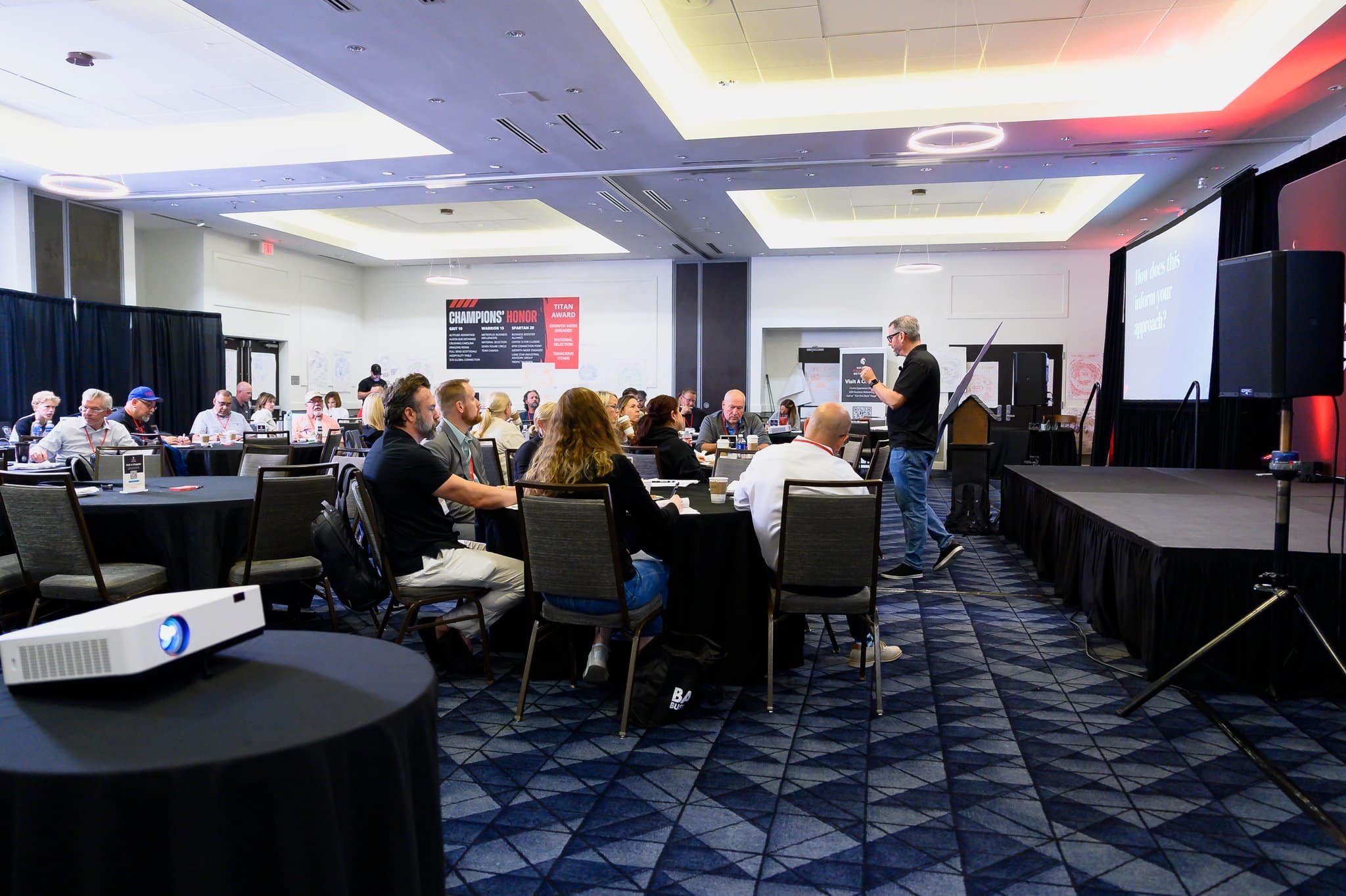
I gave this talk for EDPA, and I opened with a belief I hold harder than almost anything in business: our job as leaders is to create a predictable environment for our people to thrive. And the fastest way to wreck that environment is something I call quicksand.
The exercise
Before I gave anyone a framework, I gave them a pen.
Write down one challenging situation that’s frustrating you at work right now. Not the big strategic problem. The one that makes you sigh before a meeting. The person who isn’t delivering. The project that’s two weeks late and nobody can say why. The team that keeps asking questions you thought you’d already answered.
You’ll have one inside of ten seconds. That’s the point. Then I asked them to hold onto it, because by the end of the hour I wanted them to see their own hand in it.
What Leadership Quicksand is
Leadership Quicksand is the slide from a lack of clarity to confusion, to frustration, to broken trust, to a thin relationship, to poor performance, where the harder the leader pushes, the deeper the team sinks.
Six steps. They always run in the same order, and the first one belongs to the leader.
It starts with a lack of clarity. You know what you want. You’re sure you said it. But you said it once, in a hallway, in a language that lived in your head and not theirs. So the team gets confused. Confused people don’t announce it; they guess, and they guess conservatively. Then you see the guess, and you get frustrated, because it’s not what you asked for. The frustration leaks. A tone in a meeting. An email with one too many question marks. And trust breaks, a little, on both sides. You trust them less to do the work. They trust you a little less to be fair about it.
Broken trust means a thin relationship. Fewer real conversations, more careful ones. People stop bringing you the early bad news, because early bad news got them a look last time. And a thin relationship produces poor performance, every single time, because nobody does extraordinary work for someone they’re managing around.
Now here’s the quicksand part. What does a leader do when performance drops? Pushes. More check-ins, more oversight, more edge in the voice. Which is more pressure on a team that was never clear in the first place, which is more confusion, more frustration, more broken trust. The pushing is the sinking. It feels like leadership. It’s weight.
Look at the frustration you wrote down. Walk it backward. I’ll bet my wallet that somewhere near the beginning there was a moment when you were clear in your own head and assumed that counted.
It’s borrowed
You borrow people’s time and talent.
You don’t own either. The best engineer on your team, the salesperson who carries the quarter, the ops manager who holds the place together: they lend you the best hours of their day on the bet that the future here is worth it. That’s the whole deal. And eventually, your people leave because they no longer believe in the future. Not because of the money. Not usually because of the workload. They leave when the story about where this is going stops being credible, and quicksand is where it stops. Nobody believes in a future they can’t see clearly from where they’re standing.
So the leader’s challenge comes down to one question: did your people have a good day? A good day, not a happy one. If they can’t answer yes most days, you have quicksand somewhere, and a resignation letter on the way.
Getting out
You get out of quicksand the same way you get out of the real thing: stop thrashing, get flat, and move slowly toward something solid. The solid thing is trust, and trust stands on four pillars.
Competency: I trust you to do the thing right. Consistency: I trust you to do the thing right over time. Integrity: I trust you to do the right thing. Compassion: I trust you to do the right thing for someone because you care about them as a human being.
Run the six steps of quicksand against those four pillars and you’ll notice the order. Most leaders in trouble are plenty competent. What cracks first is consistency, because the unclear leader is unpredictable by definition, and the frustrated leader is inconsistent by mood. Repair starts there. Say the thing again. Say it the same way.Then integrity: when you realize the confusion was yours, say so out loud. Nothing rebuilds trust faster than a leader naming their own fingerprints. And compassion means remembering the person in the quicksand didn’t jump in.
The two questions I left the room with are the ones I’d leave you with. When something goes wrong, ask how it affects you, honestly, before you react. And ask how your reaction aligns with your identity as a leader. Most quicksand is a leader reacting from frustration instead of leading from identity. You can’t do both in the same sentence.
Your job is a predictable environment for your people to thrive. Stop standing in it.
I gave this as a talk for EDPA. If your room needs it, start at Speaking.