Count the people you needed something from last week, then count how many of them report to you. For most leaders the second number is a fraction of the first. The load-in crew at 6 a.m. doesn’t work for you. The executive three levels up who has to sign the thing has forty other things on the desk. The client’s client, the person who will decide whether the night was a success, has never heard your name. And even inside your own team, a title reaches about as far as your line of sight.
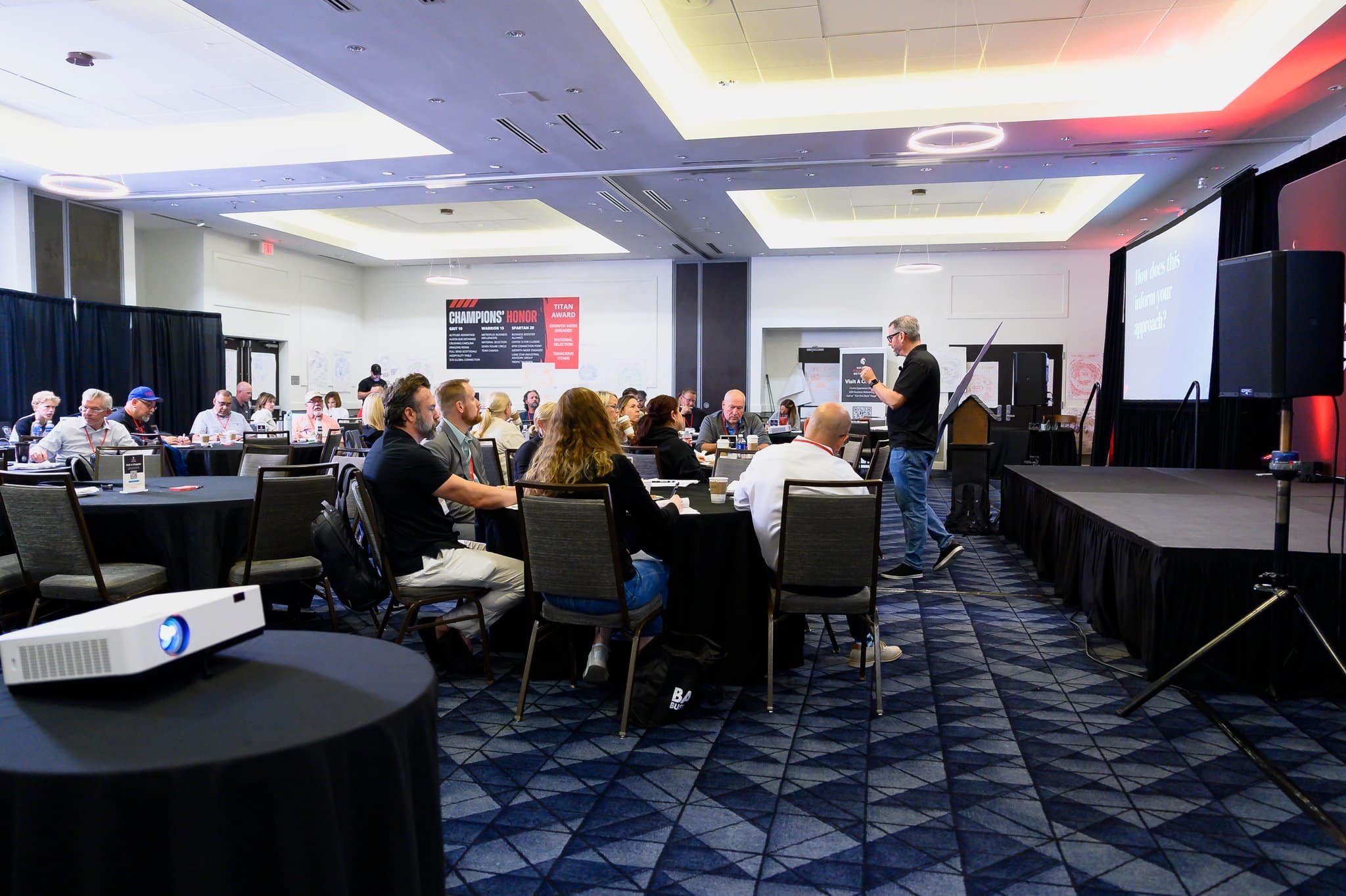
That’s the problem I walked into a room of event professionals to talk about, and nobody lives it harder. An event is a date that doesn’t move and a hundred people who can’t be ordered to care about it. I didn’t bring them an org chart. I brought them a definition and a story. Here’s both, plus the test I’d give any room that needs a yes from people it can’t direct.
The definition
Influence is the capacity to affect someone’s behavior. It’s about persuasion and inspiration, and it comes from your ability to connect, build trust, and inspire action.
Read that again and notice what isn’t in it. No title. No budget. No reporting line. That’s why I call the talk Influencing Across Layers.
Influencing across layers means moving people above you, beside you, below you, and outside your company, none of whom you can direct, by earning a yes instead of ordering one.
Authority runs one way, down. Influence runs every way. And the higher you go, the more of your day is spent with people authority can’t reach.
195 over 96
I put one memory in that deck, and it’s the one I’d rather not have.
I was in senior leadership at a company that went from $5.9 million to $15 million in eighteen months, working a hundred hours a week under a motto I said out loud: work hard, and harder. Then one Valentine’s Day my chest tightened, I couldn’t get a full breath, and by that afternoon I was on a gurney with electrodes on my chest and a blood pressure of 195 over 96. My heart was fine; the way I was running it wasn’t.
Here’s why that story is in a talk about influence. The lesson I took off the gurney was that you can’t outwork scale. The only thing that scales is other people choosing to act when you’re not in the room, and a title doesn’t buy that. A title buys compliance, and compliance shows up when you’re in the room and leaves when you do. What makes people act when you’re gone is influence. I spent my twenties trying to work around needing it.
What earns it
Everyone wants the technique. There isn’t one. There’s trust, and trust stands on four pillars, competency, consistency, integrity, and compassion, which I’ve laid out in full in The Cross the Street Test.
What matters across layers is where those pillars get built, because it’s never the big presentation. The crew chief doesn’t see your strategy. She sees whether you knew the rig plot and whether you said thank you at the end of a sixteen-hour day. The executive three levels up doesn’t see your work ethic. He sees whether the number you gave him in March held in June. The client’s client sees one night and judges everything by it. Each of those moments is a deposit or a withdrawal, and people keep an exact ledger even when they can’t quote you a single entry.
I start from the position that people are good, so trust gets given first. That’s not soft. It’s fast. Waiting for someone to earn your trust before you extend any costs you months, and across layers you don’t have months. The load-in crew has eleven hours.
The test before you open your mouth
Before any ask that matters, I run three questions, and I’d hand them to any room.
First, is it authentic? Am I asking for the thing I actually need, or a version I’ve dressed up for the meeting? The people across the table are usually better at reading that than I am at hiding it.
Second, is the intention clear? Do I know what I want out of this conversation before I walk in, and is it a result rather than a win? Most hard conversations go sideways because somebody walked in needing to be right.
Third, has the trust been earned? If I haven’t made the deposits with this person, I’m not asking. I’m hoping.
Miss any one of the three and you get a soft no, or something worse: an agreement nobody acts on, which you’ve already built a plan around.
Then the humbling part, also covered in The Cross the Street Test: you own fifty percent of any relationship, never more, so own your half so completely that the other half has nothing to push against.
In practice that means walking in curious instead of convinced. It means fighting for the work, not for the scoreboard, and leaving the relationship intact for the next conversation, because across layers there’s always a next conversation. And it means managing what you bring: your preparation, the attitude you chose in the parking lot, whether the person across from you leaves feeling seen. The outcomes follow people who manage their inputs.
The unglamorous part
The least inspiring advice I give is the advice that works. Be the same person every time. Nobody across a layer ever sees your leadership philosophy. They see your habits, because habits are the only part of you that crosses the line.
Influence isn’t something you do in the meeting. It’s what’s already true about you when you walk in, built one unremarkable follow-through at a time, for people who owe you nothing. Do that long enough and the org chart stops being the reason you get a yes. People act on your word because of who you’ve been, and they’ll keep doing it when you’re not in the room.
That’s the only kind of scale that ever held up for me. I had to lie on a gurney to learn it. You don’t.
This is the working-session version of my keynote on influence. If your room needs either, start at Speaking.